
Thematic ETFs

A Complete Practical Guide to Building a Custom "HBM+CoWoS" Index Portfolio
High-bandwidth memory (HBM) and computing power on silicon (CoPoS) have moved from niche technical terms to the center of the AI hardware story. HBM solves the bandwidth bottleneck between compute and data; CoPoS captures the performance and efficiency of GPUs, accelerators, and custom AI chips on the silicon itself. Together, they define a large part of the infrastructure that makes modern AI training and inference possible. If you want a focused, investable representation of this hardware stack, a custom "HBM+CoPoS" index portfolio is one of the most direct ways to build it.
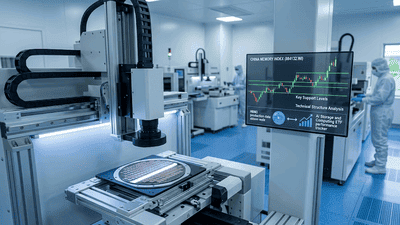
Technical Structure Analysis and Key Support Levels for China Memory Index (884132.WI)
Indexes built around memory, storage, and AI computing power have evolved from niche curiosities into important barometers for global technology cycles. Within that universe, the China Memory Index (884132.WI) stands out as a window into China’s emerging role in DRAM, NAND, and AI-oriented storage infrastructure, and as a foundation for ETFs and index derivatives targeting this theme. Technical structure analysis of such an index is more than chart-watching; it is a way of listening to how capital flows, policy shifts, and competitive dynamics are being priced in real time.

The Nonlinear Relationship Between AUM and Tracking Deviation for Memory ETFs
AI has turned memory—from DRAM and HBM to NAND and enterprise storage—into the central bottleneck of computing. As that happens, memory-focused ETFs have gone from niche to headline, with assets under management (AUM) exploding in a short span of time. Along the way, another, quieter variable starts to matter: tracking deviation. How closely do these funds actually follow the memory indices they promise to track? And how does that tracking behave as AUM grows from tiny to massive?

A Holdings Penetration Analysis of AI Compute ETFs – How Much is Memory Exposure Underestimated?
Most AI investors can recite the usual suspects in their sleep: Nvidia, AMD, Microsoft, Alphabet, maybe a sprinkling of cloud platforms and chip designers. Ask the same investors how much memory exposure—DRAM, HBM, NAND, and storage infrastructure—they actually hold through their AI compute ETFs, and the answers get fuzzier. Yet in 2026, memory has increasingly been labeled the “biggest bottleneck” in AI, and dedicated memory ETFs have quietly exploded in assets and performance.

Looking Ahead to 2027 – Product Matrix Outlook for AI Memory & Compute Thematic ETFs (Active/Passive/Leveraged)
The AI story has already split into layers. On one side, you have compute—GPUs, accelerators, ASICs, CPUs. On the other side, you have memory and storage—HBM, DRAM, NAND, SSDs, fabrics, persistence. In 2026, investors have finally started to treat memory as a theme in its own right, with first-generation memory ETFs and index derivatives turning the bottleneck into a tradable exposure. Looking ahead to 2027, it’s not hard to imagine a richer product landscape: a product matrix of AI memory and compute ETFs that come in different “styles” of intelligence and management.

An Event-Driven Rotation Calendar for Memory Thematic ETFs in 2H 2026
If 2025 was the year investors “discovered” memory as the hidden backbone of AI, then 2026 is the year that discovery turned into a full-blown rotation. Capital has been shifting from GPU-only stories into the broader AI storage and computing power stack, with memory chip ETFs quietly delivering triple-digit returns and outpacing headline semiconductor benchmarks. Against that backdrop, thinking about a second-half rotation calendar for “memory theoretical ETFs” is not just a thought experiment — it is a way to structure how you move through the cycle as key events arrive.
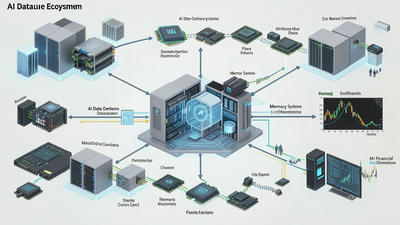
What Does the 90% Correlation Between AI Infrastructure and Memory Indices Imply?
When AI infrastructure ETFs and memory indicators move with a 90% correlation, it is more than a statistical curiosity. It is a message about how the market sees the AI stack. A correlation that high says investors are treating memory and AI infrastructure as almost the same trade: when one goes up, the other almost always does; when one goes down, the other usually follows. For ETF and index derivative users betting on AI storage and computing power, that has deep implications for allocation, risk management, and how we think about “diversification” inside the AI hardware theme.

The "Pseudo-Correlation" Trap in Thematic ETFs – Does an AI ETF Truly Represent Memory?
AI storage and computing power are two sides of the same hardware story. GPUs, accelerators, and custom AI chips get most of the attention, but without DRAM, HBM, and fast storage, they simply stall. It is therefore tempting to assume that any AI ETF—or semi ETF marketed as “AI exposure”—automatically represents memory. After all, if the fund moves with AI cycles, and AI cycles require memory, isn’t that enough?

Price Divergence Trading Strategies Between NAND Flash and DRAM ETFs
NAND flash and DRAM sit at the core of AI storage and computing power. Both are memory, but they are not the same business. DRAM is main memory—fast, volatile, and central to high‑bandwidth workloads like AI training and inference. NAND is non‑volatile storage—slower than DRAM, but crucial to persistent data and large‑scale object storage. The cycles that drive their pricing and margins overlap, yet they often diverge. That divergence is where trading strategies between NAND and DRAM ETFs become interesting.

The Logical Paradox of ESG-Screened AI Memory ETFs – Excluding High-Energy Memory Makers
AI memory is hot. ESG is hot. Put them together and you get something that looks clever on paper: an ESG-screened AI memory ETF, promising exposure to the hardware bottleneck that powers neural networks while still respecting environmental, social, and governance criteria. It sounds neat. It may even sound inevitable. But once you dig under the narrative, a paradox appears: the companies that dominate AI memory are also the ones consuming enormous amounts of energy and resources. Screening them for ESG while simultaneously making them the cornerstone of an AI storage and computing theme is not as simple as a checklist.
Popular

Narrowing Spread Between NAND Spot and Contract Prices in 2026 – A Signal
By 2026, one of the most watched metrics in the NAND flash market has started to shift in a subtle but meaningful way: the spread between spot prices and long‑term contract prices is narrowing. For casual observers, this may look like just another incremental change in a notoriously volatile industry. For memory makers, module houses, device OEMs, and data center buyers, however, a tightening gap between spot and contract prices is a signal—a reflection of evolving supply–demand balance, risk perceptions, and strategic behavior on both sides of the market.
Price Divergence Trading Strategies Between NAND Flash and DRAM ETFs
NAND flash and DRAM sit at the core of AI storage and computing power. Both are memory, but they are not the same business. DRAM is main memory—fast, volatile, and central to high‑bandwidth workloads like AI training and inference. NAND is non‑volatile storage—slower than DRAM, but crucial to persistent data and large‑scale object storage. The cycles that drive their pricing and margins overlap, yet they often diverge. That divergence is where trading strategies between NAND and DRAM ETFs become interesting.

China’s HBM Localization Progress: The Catch-Up Pace of CXMT and XMC
China’s drive to localize advanced memory technologies has accelerated over the past several years. High-Bandwidth Memory (HBM) sits near the center of that strategy because it is integral to AI accelerators, high-performance computing (HPC) and other strategic compute platforms. Two domestic players—ChangXin Memory Technologies (CXMT) and XMC (Xianghui Memory, commonly referred to as XMC)—have become focal points in assessing how quickly China can close the gap with international incumbents on HBM die, stacking, and packaging.